Bird nails may need professional attention when they interfere with stable grip, alter the way the toes sit on a perch, snag repeatedly or grow abnormally. Naturally sharp nails are not automatically overgrown.
There is no universal trimming calendar for every bird. Species, body size, activity, perch design, health and individual growth affect the need.
Signs a bird’s nails may be too long
Look for changes such as:
- difficulty gripping a perch;
- toes sitting at an unusual angle;
- repeated snagging on fabric or enclosure items;
- unstable movement;
- nails curling excessively;
- or one nail growing differently from the others.
Sharpness alone is not enough. Birds need their nails for balance and grip.
Why stable grip matters
The goal of nail care is not to make every nail blunt.
Removing too much length can reduce stability, especially for a small bird. A professional should preserve enough nail for safe perching.
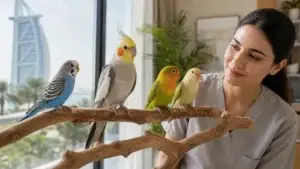
Observe the bird on different perch diameters. If the toes cannot wrap naturally or the nail changes the foot position, assessment may be appropriate.
Perches and natural wear
Perch variety affects feet and nail wear.
A suitable enclosure may include natural branch-style perches with different safe diameters and textures. One abrasive perch should not be treated as a complete solution.
Very rough products can irritate the feet. An avian veterinarian can advise when foot condition or perch setup is contributing to a problem.
How often should bird nails be assessed?
The interval varies.
A practical approach is to check the nails regularly and compare:
- grip;
- movement;
- nail shape;
- and changes from the bird’s normal condition.
Some birds need more frequent care than others. A fixed monthly trim can lead to unnecessary work.
The broader bird grooming frequency guide explains why grooming should be condition-based.
When professional nail care is useful
Professional help may be appropriate when:
- the owner cannot assess the nail safely;
- the bird is difficult to handle;
- the nails repeatedly snag;
- the bird’s grip appears affected;
- the bird is very small;
- or several grooming concerns can be assessed together.
The provider should have experience with the species and should minimise restraint time.
When an avian veterinarian is needed
Contact an avian veterinarian for:
- bleeding or injury;
- swelling;
- foot sores;
- abnormal nail colour;
- rapidly changing growth;
- pain;
- weakness;
- poor balance;
- or simultaneous beak overgrowth.
Abnormal nail growth can be connected to health problems. Grooming should not delay medical assessment.
What owners should not do
Do not:
- follow a generic nail-length diagram without considering species;
- use forceful restraint;
- give medication;
- or attempt the procedure when the bird is struggling or breathing heavily.
This article does not provide a clipping tutorial because incorrect handling or excessive shortening can cause harm.
SMS bird nail care in Dubai
The current SMS Bird Basic package displays nail clipping and filing within its at-home service.
Before booking, provide:
- species;
- age;
- health conditions;
- flight status;
- handling history;
- and the specific nail concern.
Review the current packages on the bird grooming page.
Related grooming guides
Frequently asked questions
How often should bird nails be trimmed?
There is no single interval. Trim only when length or shape creates a genuine need.
Are sharp parrot nails abnormal?
Not necessarily. The key issue is function, not owner comfort alone.
Can a cement perch replace nail care?
No single perch should be relied on. Perch variety and foot health matter.
Should a groomer or veterinarian trim the nails?
Routine care may be handled by an experienced bird professional. Injury, abnormal growth or illness belongs with an avian veterinarian.
Is nail trimming included in every bird appointment?
Package inclusions must be confirmed, and the service should be performed only when appropriate.