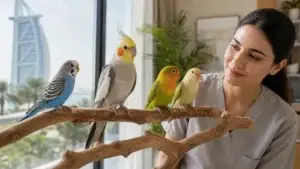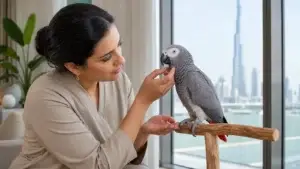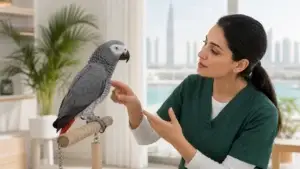
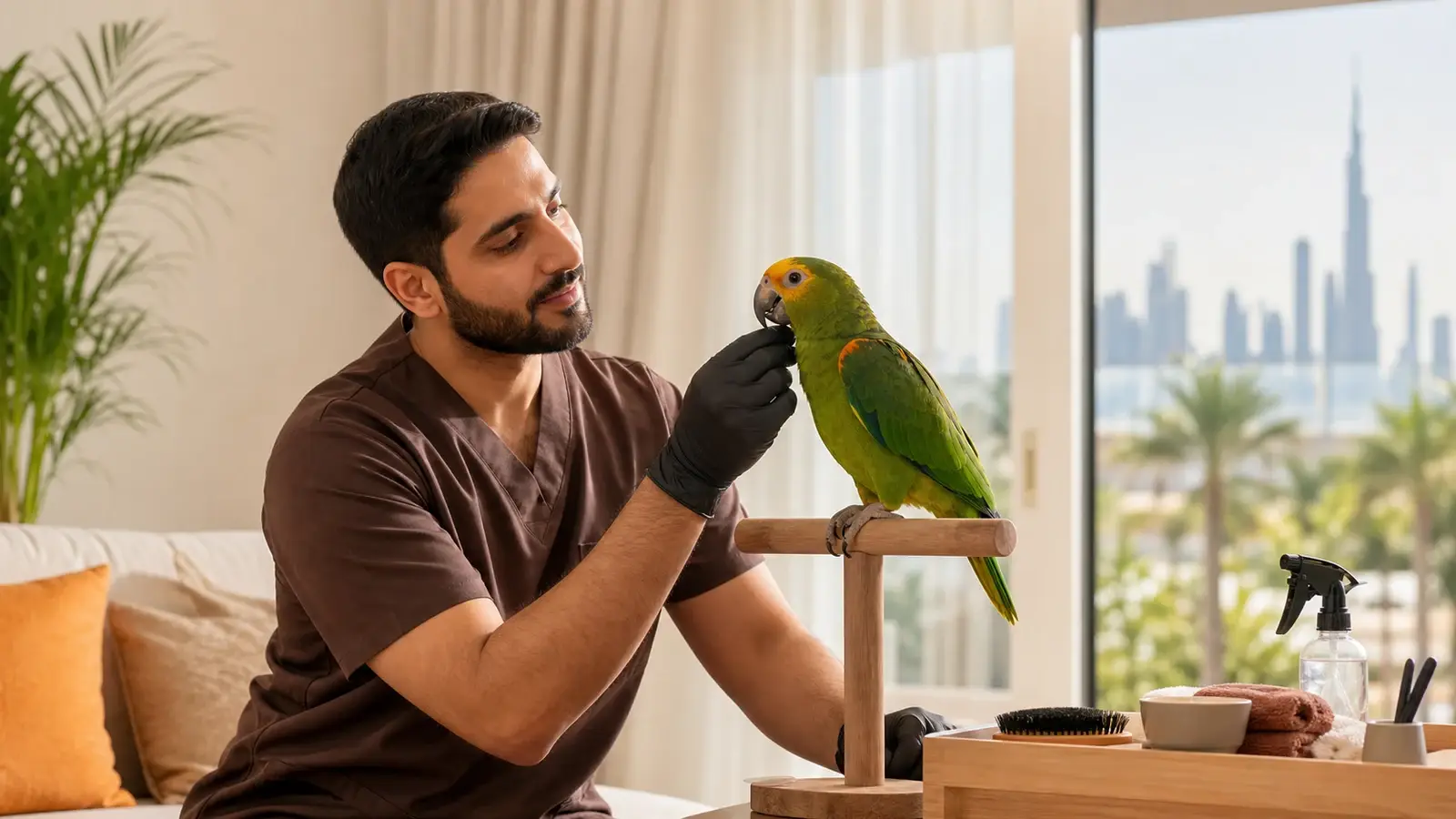
Professional bird grooming may include checking and shortening overgrown nails, supporting species-appropriate bathing and feather care, observing the beak and discussing wing feathers. It should not mean that every bird automatically receives a nail trim, beak trim, bath and wing clip.
Birds differ by species, body size, activity, perch environment, health and flight status. A responsible appointment begins with assessment. Abnormal beak growth, damaged feathers, breathing difficulty, wounds or signs of illness belong with an avian veterinarian.
Bird grooming components at a glance
| Grooming component | When it may be appropriate | Important limitation |
|---|---|---|
| Nail assessment and trim | Nails interfere with grip, movement or snag repeatedly | Enough nail must remain for stable perching |
| Beak observation | Routine visual check for shape and wear | Healthy beaks usually do not need routine trimming |
| Bathing or feather cleaning | Species enjoys bathing or feathers need suitable cleaning | Method and products must be bird-safe |
| Feather and moult check | Loose, damaged or developing feathers need observation | Abnormal feather loss needs veterinary assessment |
| Wing-feather discussion | Owner is considering a flight-management decision | Wing trimming is not required for every bird |
| General external check | Feet, skin, feathers and posture are observed | Grooming does not replace a veterinary examination |
The appointment should select only the components that are suitable for the individual bird.
Nail assessment and care
Bird nails naturally support grip and balance. A nail can feel sharp to a person without being abnormally long.
Professional attention may be useful when nails:
- interfere with stable perching;
- change how the toes sit on the perch;
- snag repeatedly on fabric or enclosure items;
- make movement difficult;
- or grow in an unusual direction.
The aim is not to make every nail blunt. Removing too much length can reduce grip and cause injury.
Perch variety, species, activity and individual growth influence how often nails need attention. One universal monthly schedule does not fit all birds.
Read the dedicated bird nail-trimming guide for the signs that matter most.
Does a bird’s beak need trimming?
A healthy beak grows continuously but also wears through eating, chewing and normal activity. Merck Veterinary Manual states that routine beak trimming is usually unnecessary in healthy birds with appropriate chewing opportunities.
A beak should be assessed by an avian veterinarian when it becomes:
- clearly overgrown;
- asymmetrical;
- cracked or bleeding;
- unusually soft;
- discoloured;
- or associated with difficulty eating.
Beak overgrowth may be connected to nutrition, disease, trauma or abnormal wear. Treating it as a cosmetic problem can delay proper care.
A grooming provider may observe and report a concern, but complex beak work belongs with an avian veterinarian.
Bathing and feather cleaning
Many birds maintain their feathers through preening and species-preferred bathing. Some prefer a shallow dish, some enjoy a gentle mist and others respond to a shower-like environment.
Professional bathing may be considered when:
- the bird’s normal bathing routine is difficult to maintain;
- feathers are dusty or soiled;
- the owner needs help identifying a suitable method;
- or bathing is included as part of a carefully selected appointment.
Plain clean water is usually the safest default unless an avian veterinarian has recommended a specific product. Fragrances and unverified grooming products should not be assumed safe for birds.
A frightened bird should not be forced through a bath simply to complete a package.
Feather condition and moulting
Normal feathers should be observed for:
- cleanliness;
- symmetry;
- damage;
- broken shafts;
- abnormal loss;
- and changes during moult.
Moulting is a normal process, but sudden feather loss, persistent bald areas, damaged skin, excessive picking or major changes in feather quality require veterinary assessment.
A groomer can help with general observation and suitable cleaning. A groomer should not diagnose the reason for abnormal feather loss.
Wing and flight-feather decisions
Wing trimming is an individual management decision, not a standard hygiene service.
Before considering it, the owner should discuss:
- the bird’s species and age;
- current flight ability;
- household doors, windows, fans and other hazards;
- training and recall;
- the bird’s physical condition;
- the reason for wanting the trim;
- and the effect on exercise and confidence.
Wing trimming does not guarantee that a bird cannot fly or escape. An aggressive trim can reduce stability and increase the risk of falls.
No owner should be pressured to select wing trimming simply because it appears in a Full Grooming package. Read the planned wing and feather-trimming guide before making the decision.
What should not be treated as routine grooming?
The following concerns should not be handled as ordinary cosmetic work:
- abnormal beak growth;
- wounds or bleeding;
- breathing difficulty;
- weakness or poor balance;
- sudden feather loss;
- severe feather picking;
- swollen feet;
- abnormal droppings;
- reduced appetite;
- or a major change in behaviour.
These signs require an avian veterinarian.
Medication or sedation also belongs to a veterinarian. A groomer should never tell an owner to give unprescribed medication before an appointment.
SMS Bird Basic and Full Grooming
Client-provided service records show two mobile bird-grooming options at the customer’s Dubai home:
| Package | Recorded starting price | Displayed scope |
|---|---|---|
| Bird Basic Grooming | AED 200 | Nail care, beak-related service and cleaning elements are displayed |
| Bird Full Grooming | AED 260 | Adds feather or wing-related work to the displayed package |
The live bird grooming page should be checked before booking. More importantly, every displayed component should be discussed for species suitability. A bird should receive only what is actually needed and safe.
What information should owners provide?
Before booking, share:
- species and approximate age;
- current flight status;
- known medical conditions;
- medication;
- previous grooming reactions;
- nail, beak or feather concern;
- recent changes in eating, droppings or behaviour;
- and whether an avian veterinarian has evaluated the concern.
Photos can help explain the issue, but they do not replace an examination.
Questions to ask a bird-grooming provider
- What bird species do you regularly handle?
- How do you minimise restraint time?
- How do you monitor breathing and stress?
- When do you stop the appointment?
- Which products are used for bathing or cleaning?
- Do you perform beak work, and when do you refer to an avian veterinarian?
- How do you decide whether nails are truly overgrown?
- Is wing trimming optional?
- What happens if the bird is too stressed to continue?
- How are tools cleaned between birds?
Experience with dogs and cats does not automatically prove bird-handling competence.
Book bird grooming at your Dubai home
SMS Pet Grooming offers bird grooming at the customer’s Dubai home. Before choosing a package, explain the bird’s species, flight status, health and exact grooming concern.
Review the current service on the mobile bird grooming page and confirm which components are appropriate.
Related grooming guides
Frequently asked questions
Do all pet birds need professional grooming?
No. Many birds maintain their feathers and beaks through normal behaviour. Professional care may be helpful for overgrown nails, a specific cleaning need or an informed wing-feather decision.
How often should a bird have its nails trimmed?
There is no universal interval. Nail growth, species, activity, perch setup and grip determine the need.
Should a healthy bird’s beak be trimmed?
Usually not. An overgrown or abnormal beak should be assessed by an avian veterinarian.
Is wing clipping part of every bird grooming appointment?
It should not be. Wing trimming is an individual decision and should be optional.
Can a groomer treat feather loss?
No. A groomer may observe and report abnormal feather loss, but diagnosis and treatment belong to an avian veterinarian.