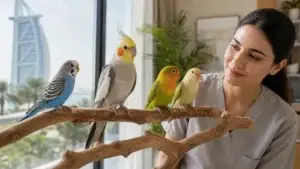
Wing trimming is not automatically required for pet birds. Flight is natural behaviour and provides exercise. An aggressive or unsuitable trim can reduce stability, increase fall risk and affect confidence.
The decision should consider species, age, flight skill, household safety, owner goals and the bird’s health.
What wing trimming can and cannot do
A conservative trim may reduce sustained or upward flight.
It does not guarantee that a bird:
- cannot fly;
- cannot escape;
- cannot reach a hazard;
- or will become easier to handle.
Wind, fear and growing feathers can change flight ability.
Benefits of maintaining safe flight
Flight supports:
- exercise;
- balance;
- coordination;
- confidence;
- and species-typical behaviour.
A flighted bird still needs a safe home, closed doors, protected windows, switched-off fans and training.
Risks of aggressive trimming
Removing too many flight feathers may cause:
- uncontrolled falls;
- poor landing;
- chest injury;
- broken feathers;
- reduced exercise;
- and behavioural effects.
Young birds need the opportunity to develop flight and landing skill.
Questions to ask before consenting
Ask:
- Why is the trim being recommended?
- What behaviour or safety problem is it intended to address?
- Has the bird learned to fly and land?
- Which species-specific risks apply?
- How will moult change the result?
- Is the trim optional?
- What alternatives have been considered?
- Who will perform it?
- What happens if the bird becomes distressed?
- When is veterinary involvement required?
A package should not make the decision automatically.
Moult and feather regrowth
Flight feathers are replaced during moult.
As new primaries grow, flight ability can change unexpectedly.
Owners should continue household safety precautions even after a trim.
Is wing trimming needed to prevent escape?
No trim can guarantee zero flight.
Escape prevention depends on:
- doors;
- windows;
- screens;
- fans;
- outdoor handling;
- carriers;
- and trained recall where appropriate.
Physical safety systems remain necessary.
Who should perform the service?
The provider should have species-specific bird experience and understand:
- feather anatomy;
- balance;
- respiratory sensitivity;
- stress;
- and conservative decision-making.
This article does not provide feather-count or cutting instructions.
SMS Bird Full Grooming
The current SMS Bird Full package displays feather or wing clipping.
Before booking, provide species, age, flight history and the reason for considering the service.
Ask whether the component is optional and how the provider evaluates suitability.
Review the current bird grooming page.
Related grooming guides
Frequently asked questions
Does wing clipping stop a bird from flying?
No. Many trimmed birds can still fly or glide.
Is wing clipping cruel?
The welfare impact depends on the bird, reason and extent. It should never be automatic.
How often are wings clipped?
Timing depends on moult and individual need. There is no fixed universal schedule.
Should young birds be clipped?
Flight development and landing skill should be considered with an avian professional.
Can I clip wings at home?
This article does not provide instructions. Incorrect trimming and restraint can cause harm.