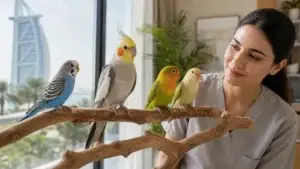
There is no universal professional-grooming schedule for pet birds. Nail, beak, bathing and wing-feather needs should be assessed separately according to species, activity, perch environment, health, moult and owner goals.
A package should not automatically be repeated every month with every component.
Bird grooming is several different schedules
| Component | Timing principle |
|---|---|
| Nails | When length affects grip, movement or snagging |
| Beak | Healthy beaks usually do not need routine trimming |
| Bathing | Species and individual preference |
| Feather observation | Ongoing, especially during moult |
| Wing trimming | Individual decision, not routine hygiene |
| Veterinary assessment | Any abnormal growth, injury or illness |
Each component answers a different need.
Nail-care timing
Check the bird’s:
- grip;
- toe position;
- movement;
- nail shape;
- and repeated snagging.
Sharpness alone does not prove overgrowth.
Read the bird nail-trimming guide.
Does the beak need regular trimming?
Usually not.
A healthy beak wears through normal eating, chewing and activity.
Overgrowth, cracking, bleeding, softness, asymmetry or eating difficulty requires an avian veterinarian.
Read Bird Beak Care.
Bathing and feather care
Some birds bathe frequently, while others prefer occasional misting or a shallow dish.
Use the bird’s species and preference. Do not force a frightened bird through a bath only to complete a package.
Plain clean water is generally the default unless an avian veterinarian recommends another product.
How moult changes timing
During moult, new feathers replace old ones.
Wing flight ability and feather condition can change as new primary feathers grow.
The timing of any wing-feather decision should consider moult rather than a fixed date.
Does every bird need wing trimming?
No.
Flight is natural behaviour and supports exercise. Wing trimming is an individual household and welfare decision.
It does not guarantee that a bird cannot fly or escape.
Species and size differences
A budgie, African Grey and macaw should not be handled or assessed in exactly the same way.
Body size, respiratory sensitivity, nail function, flight skill and stress tolerance vary.
The provider should ask the species before selecting services.
When an avian veterinarian is needed
Contact an avian veterinarian for:
- abnormal beak growth;
- nail injury;
- breathing changes;
- weakness;
- severe feather loss;
- wounds;
- reduced appetite;
- abnormal droppings;
- or a major behaviour change.
Grooming does not replace medical assessment.
Selecting an SMS bird package
SMS Pet Grooming displays Basic and Full bird packages at the customer’s Dubai home.
The package should be treated as a list of possible components, not a requirement to complete everything.
Share species, age, flight status and the exact concern before booking through the bird grooming page.
Related grooming guides
Frequently asked questions
Do birds need monthly grooming?
Not automatically. Assess each component by need.
How often should bird nails be trimmed?
Only when length or shape creates a functional concern.
How often should a beak be trimmed?
Healthy beaks usually do not require routine trimming.
How often should wings be clipped?
Wing trimming is optional and should be discussed individually after moult and flight are considered.
Can a groomer identify illness?
A groomer can observe changes but diagnosis belongs to an avian veterinarian.